
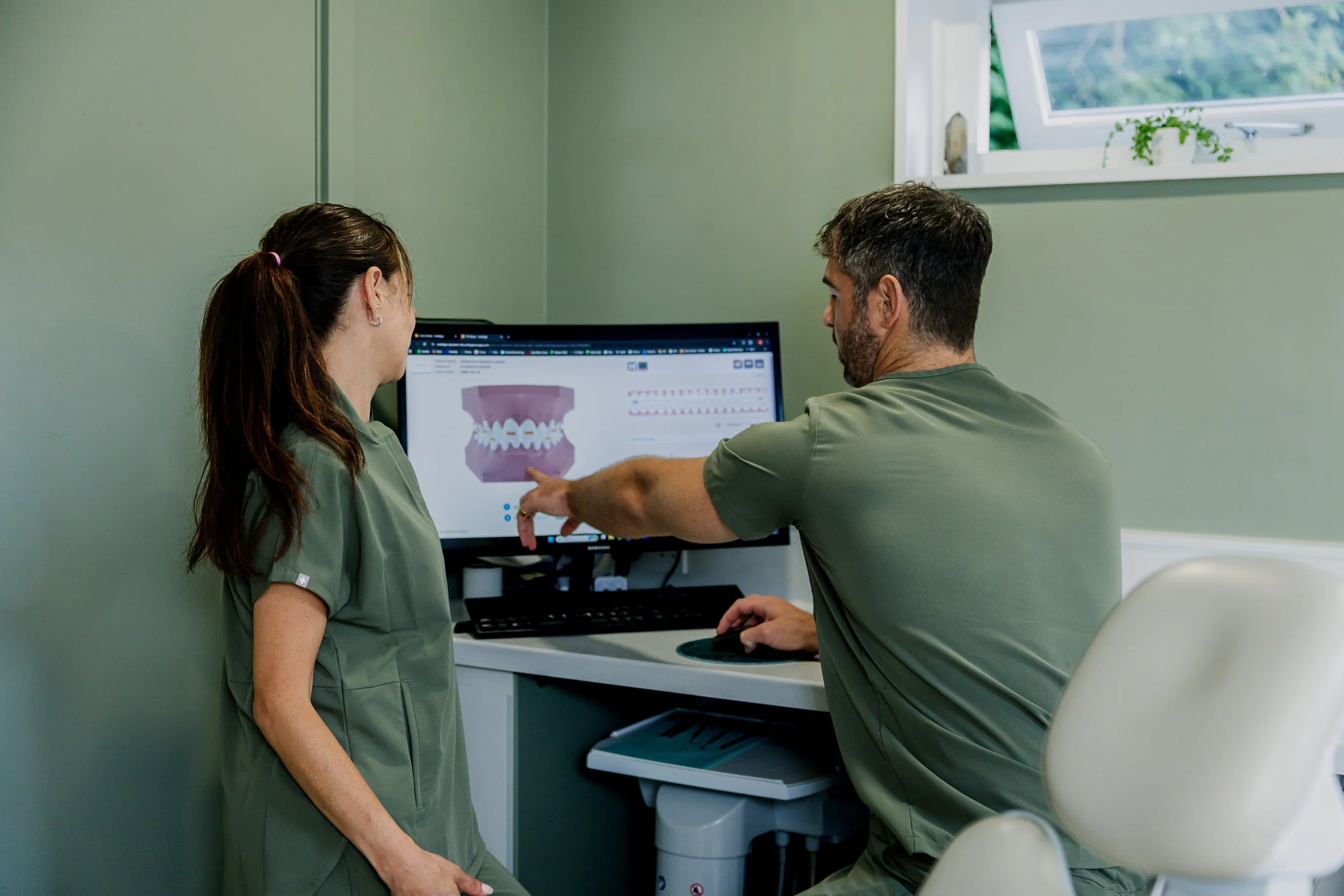
Dental Facial Orthopaedics and Orthodontics
This information is provided to help you understand the treatment we are recommending. It is intended to support discussion and does not replace a full individual assessment.
Dental Facial Orthopaedics:
For many people, the term Dental Facial Orthopaedics (DFO) will be unfamiliar. In simple terms, it refers to treatment that aims to influence the growth and relationship of the bones of the face and jaws in growing patients.
In some cases, this approach may help reduce the likelihood of extractions and may improve facial balance. However, the need for extractions, and the extent to which facial profile changes are possible, will depend on the individual case and cannot be guaranteed.
We use a combination of appliances to guide growth where appropriate, followed by fixed braces or clear aligners to align the teeth. The exact combination of appliances, braces, oraligners is tailored to each patient depending on their bite, tooth position, and jaw relationships.
There is currently some evidence base for some aspects of DFO, and outcomes may be less predictable than with more established orthodontic approaches. In the UK, this type of treatment is not routinely used by all orthodontic providers, so we will discuss with you why it may be suitable for your child’s individual needs.
Orthodontics:
Orthodontics is the term used for moving teeth and correcting their alignment. This is usually achieved with fixed braces or clear aligners.
Removable orthopaedic appliances may help guide jaw growth in selected cases, but they do not usually align teeth on their own. Likewise, fixed or removable braces can align teeth but do not directly change the underlying jaw structure. For this reason, a combination of approaches is sometimes recommended.
Diagnosis and Treatment Planning:
The first step in treatment is to understand the nature of the problem as fully as possible. To do this, we use a detailed assessment, radiographs, and study models where needed to help determine the most appropriate treatment plan.
Once these assessments have been completed, we will discuss the proposed treatment with you, including the expected benefits, risks, limitations, alternatives, and likely costs, so that you can make an informed decision about whether to proceed.
It is important to understand that orthodontic and jaw-related treatment is often more complex than simply straightening crooked teeth. A key aim of DFO treatment is to improve tooth position and, where indicated, support a more favourable relationship between the jaws and facial structures. Treatment may therefore take longer than conventional fixed braces in some cases.
DFO Appliances:
Depending on the treatment required, it may be possible to go straight into clear aligners. More commonly, we may use removable orthopaedic appliances first to guide growth gradually. Clear aligners or fixed braces are then used once growth has progressed sufficiently and the permanent teeth have erupted as needed.
Most orthopaedic appliances are worn full time and removed only for adjustment and cleaning, according to the instructions given.
In some children, the upper jaw (maxilla) is either too narrow or positioned further back in relation to the lower jaw. This can affect the bite and facial growth, and in some cases may also be associated with breathing issues. If appropriate, we may recommend a combination of expansion and facemask therapy.
The expansion appliance is fitted inside the mouth and is used to gently widen the upper jaw over time. This may help create space and correct crossbites. Once expansion has started, a facemask, also called reverse pull headgear, may be used to encourage forward movement of the upper jaw.
The facemask is worn outside the mouth and attached to the expansion appliance with small elastics. These elastics apply a gentle forward pulling force to the upper jaw, helping to improve the bite in selected cases.
For best results, the facemask should usually be worn daily for the number of hours advised, often in the evening and overnight. Consistent wear is very important because this treatment depends on light, continuous forces over time.
This type of treatment is generally more effective while a child is still growing, which is why early interceptive orthodontic treatment may be recommended in selected cases. Good cooperation is essential, and the response to treatment can vary from patient to patient.
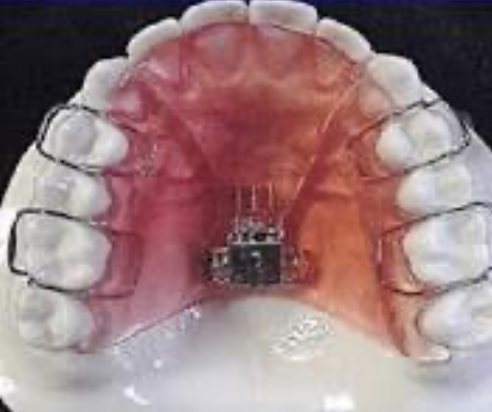
A 3D Schwartz Appliance
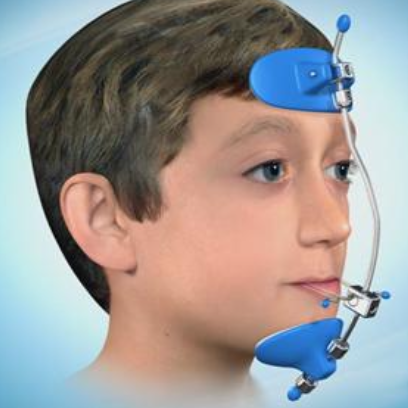
Face Mask
Oral Myofunctional Therapy and Tongue Position:
We are continuing to learn more about the role of tongue posture, swallowing pattern, and nasal breathing in facial and dental development. During treatment, we may recommend daily exercises or habit correction measures to support your child’s oral function.
These exercises may help with oral habits and may support tooth stability in some patients, although the benefits are variable and some wider health claims have not been conclusively proven. If we feel this would be helpful, and after discussing it with you, we may refer your child to an appropriately trained oral myofunctional therapist or another relevant specialist.
This will always be discussed with you before treatment is started.
Retainers:
We will recommend the type of retainer that is most suitable for each patient to help maintain the position of the teeth. Whatever type is used, it is very important that the retainer is worn according to the dentist’s instructions.
As with all orthodontic treatment, there is a risk of some tooth movement over time. For this reason, long-term retention is often needed, and many patients are advised to wear retainers at night for an extended period. The recommended duration will depend on the individual case.
Alternative Options:
Possible alternatives may include:
• Referral to a specialist orthodontist for a second opinion.
• Monitoring growth and delaying active treatment until later.
• Conventional fixed braces alone, if appropriate.
• No active treatment at this stage.
• NHS orthodontic assessment, where eligible and available.
Important note:
Dental Facial Orthopaedics is not an exact science. The aim is to achieve a healthy, functional, and aesthetically pleasing result rather than absolute perfection. Treatment outcomes vary between patients, and additional treatment may sometimes be needed in the future.
We encourage you to share any questions, concerns, or expectations at any stage of treatment or before giving consent so we can support you and your child throughout the process.
Warm Regards,
Angelica Londono-Forero
BDS, Professional master's degree in Orthodontics and Dentofacial Orthopedic.